Reach the patients other programs miss.
Pre-configured cellular devices arrive at the patient’s home ready to use. No smartphone, no Wi-Fi, no setup call, no app to learn. For patients without broadband, without a device, or without the confidence to pair one, that is the difference between a program they join and a program they abandon.

When something changes, a patient reaches a person.
Not a portal ticket and not a phone tree. The same navigator who works the care plan, by name.
A patient reports something
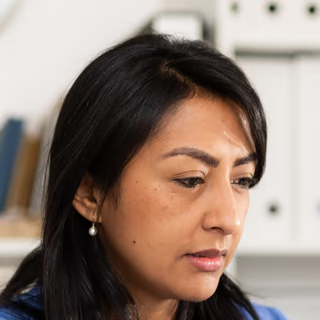
- Beatriz R., 64PatientI have been light-headed since Saturday morning.
- Nurse AlvarezCare NavigatorHi Beatriz, thanks for letting me know. Your readings have looked steady, so I’m going to give you a call in a few minutes to check-in.

Who decidesThe navigator escalates and documents. The provider makes the clinical call.
Customer story
We continue to be encouraged by the clinical outcomes of HealthSnap’s virtual care management programs in areas notoriously below the national standards of healthcare outcomes.
 Angela Orsky, DNP, LNHA, RNSVP, Value-Based Care & Clinical Integration, Prisma Health
Testimonials are from real, uncompensated clinicians and patients who volunteered their statements. Individual results vary.
What you get
Multi-language patient support
Supports HRSA and FCC Telehealth grant awards
Rural monitoring over 4G LTE
Nothing to pair, nothing to learn.
Every device arrives ready to transmit on the strongest cellular network — nothing to pair or set up, and no smartphone or Wi-Fi required. The patient app exists for the people who want it, not as the thing the program depends on. That is what keeps enrollment from failing in the populations an app-led program never reaches.
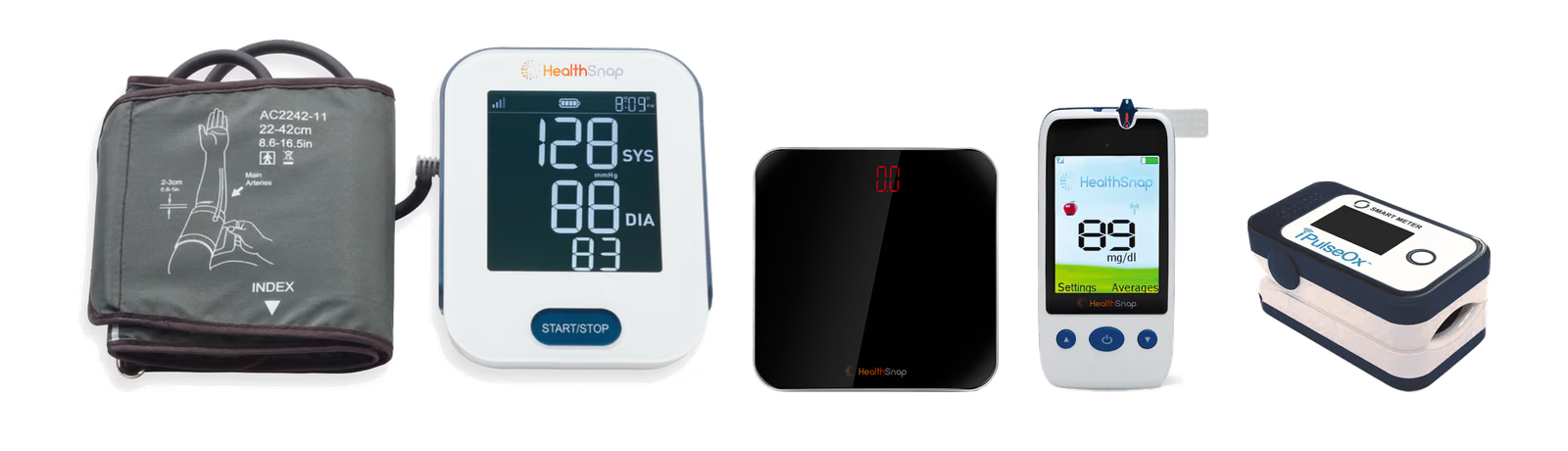
Transmits on its own over 4G LTE
70.8%below 140/90 at last reading30,098 monitored patients
It works in the populations where control is hardest.
85.3% → 69.6%Where this number comes fromPopulationOuter Cape Health ServicesSourceCustomer storyVerifiedApril 2024Observational and single-arm — reported as an association, not causation.
share of monitored patients with uncontrolled hypertension, Outer Cape Health Services
−12.86 mmHgWhere this number comes fromPopulationOuter Cape Health ServicesSourceCustomer storyVerifiedApril 2024Observational and single-arm — reported as an association, not causation.
mean systolic among uncontrolled patients (150.33 → 137.47), Outer Cape Health Services
And outcomes do not degrade as patients get more complicated: across 30,098 monitored patients, systolic reduction was essentially flat across comorbidity burden, and patients carrying one to three additional conditions reached target more often than those with hypertension alone. Outer Cape figures: 83.9% of uncontrolled patients improved their systolic pressure, and diastolic fell 7.61 mmHg. Observational and single-arm.
Community health centers and FQHC-led networks running HealthSnap.


Programs available to you
Remote Patient Monitoring, Chronic Care Management and Advanced Primary Care Management, with FQHC and RHC billing supported. APCM in particular suits community health: flat monthly reimbursement with no billable-minute threshold, so outreach flexes to what each patient actually needs.